Digital Nomad Visa Countries 2026: Complete Guide
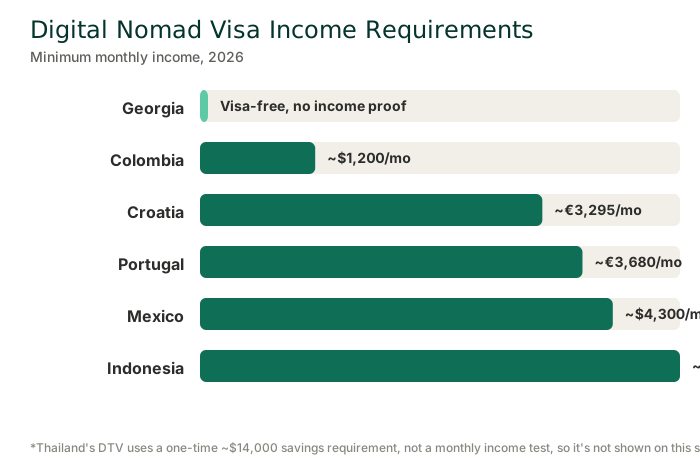
More than 50 countries now offer a dedicated digital nomad visa, letting remote workers live abroad legally for 6 months to 2+ years. Income thresholds range from about $1,200/month (Colombia) to $4,400/month (Mexico), and rules on tax residency and family inclusion vary significantly by country.
What Is a Digital Nomad Visa?
A digital nomad visa is a residence permit built specifically for remote workers — employees, freelancers, or business owners — who earn income from outside the country they want to live in. Unlike a standard tourist visa, it explicitly authorizes remote work and typically allows stays of 6 months to 2 years, sometimes longer, without needing local employment or sponsorship.
Which Countries Offer Digital Nomad Visas in 2026?
More than 50 countries now run some version of this program. Below are the destinations we cover on HannaTrip, with current 2026 income thresholds and stay lengths.
| Country | Income requirement | Max stay | Guide |
|---|---|---|---|
| Colombia | ~$1,200-1,400/mo | 2 years | Colombia guide |
| Georgia | No formal minimum (visa-free stay) | 365 days | Georgia guide |
| Croatia | ~€3,295/mo | 18 months | Croatia guide |
| Portugal (D8) | ~€3,680/mo | 1 year, renewable to PR | Portugal guide |
| Thailand (DTV) | ~500,000 THB (~$14,000) in funds | 180 days per entry, 5-year visa | Thailand guide |
| Mexico (Temp. Resident) | ~$4,300-4,500/mo or ~$73,000 savings | Up to 4 years | Mexico guide |
| Indonesia (Remote Worker E33G) | ~$60,000/year | 1 year, renewable | Bali guide |
| UAE (Virtual Working) | No formal minimum; proof of remote income | 1 year | Dubai & UAE guide |
| Spain | ~€2,849/mo | 1 year, renewable up to 5 | Spain guide |
| Italy (highly skilled only) | ~€28,000/year | 1 year, renewable | Italy guide |
Which Digital Nomad Visa Should You Choose?
Georgia is the easiest entry point for most people since it requires no formal digital nomad application at all — just the standard visa-free stay of up to 365 days for 95+ nationalities. Colombia and Croatia are the next tier: genuinely accessible income thresholds with a real application process. Portugal and Thailand suit people planning a longer-term relocation, since both offer multi-year pathways. Mexico and Indonesia sit at the higher end of the income bar, better suited to established freelancers or salaried remote employees. Spain sits in the middle of the pack alongside Colombia and Croatia, while Italy is the most restrictive of the group, open only to "highly skilled" applicants rather than any remote worker.
Does a Digital Nomad Visa Affect Your Taxes?
Most countries apply the standard 183-day rule: spend more than half the year there and you typically become a tax resident, liable for local tax on some or all of your income, regardless of your visa type. Croatia is the standout exception, explicitly exempting digital nomad visa holders from local income tax on foreign-sourced earnings even past 183 days. This is genuinely complex and country-specific — talk to a tax professional familiar with both your home country and destination before making decisions based on visa marketing copy alone.
Wherever you land, get connected the moment you arrive.
Use code Sahrzad15 at checkout for a discount.
For connectivity specifically, see the best eSIM-friendly countries for digital nomads, or browse individual destination guides for visa details and local tips.
Frequently asked questions
What is a digital nomad visa?
A residence permit that lets remote workers legally live in a country for an extended period, typically 6 months to 2 years, while working for employers or clients based outside that country. It's different from a tourist visa, which usually doesn't authorize any work, remote or otherwise.
Which digital nomad visa has the lowest income requirement?
Colombia's is among the most accessible, requiring roughly 3x the local minimum wage (about $1,200-1,400/month in 2026). Croatia and Portugal sit in the $3,000-3,700/month range, and the UAE's virtual working program has no formal minimum but expects proof of stable remote income.
Do digital nomad visas make you a tax resident?
It depends on the country and how long you stay, but most trigger tax residency after 183 days in a calendar year, regardless of visa type. Croatia is a notable exception, exempting digital nomad visa holders from local tax on foreign-sourced income even past 183 days. Always confirm with a tax professional for your specific situation.
Can I apply for a digital nomad visa after I've already arrived as a tourist?
It varies by country. Colombia has increasingly rejected in-country applications from tourist status; Thailand's DTV and Portugal's D8 generally require applying from outside the country. Check the specific country's current process before planning around this.
Do digital nomad visas count toward permanent residency?
Usually not. Most digital nomad visas (Colombia, Croatia) explicitly don't accrue toward citizenship or permanent residency timelines. Portugal's D8 is a notable exception, offering a genuine path to permanent residency after 5 years.
Which European country has the most restrictive digital nomad visa?
Italy, among the countries HannaTrip covers. Its visa is limited to "highly skilled" applicants — generally a degree or several years of relevant experience — rather than being open to any remote worker the way Spain's, Portugal's, or Croatia's programs are.