eSIM vs. Roaming: Which Is Cheaper?
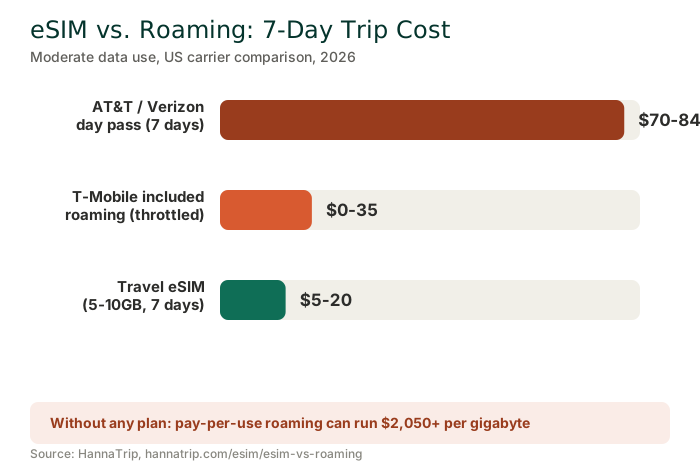
A travel eSIM is almost always cheaper than carrier roaming. US carrier day passes typically run $10-12/day, while a travel eSIM covers the same trip for $5-20 total depending on data needs — often a 70-90% saving over a week or more abroad.
How Much Does Carrier Roaming Cost?
According to carrier pricing pages compiled in 2026, AT&T and Verizon both charge around $10-12 per day for an international day pass, while T-Mobile includes free data abroad but throttled to a barely usable 256 Kbps unless you pay for a speed upgrade. Without any day pass at all, pay-per-use rates apply automatically the moment your phone connects to a foreign network — AT&T's published rate of $2.05/MB works out to roughly $2,050 per gigabyte. According to the GSMA in 2026, international roaming still generates over $50 billion a year in carrier revenue, much of it from travelers who never opted into a plan at all.
How Much Does a Travel eSIM Cost for the Same Trip?
Travel eSIM pricing is data-based rather than per-day, and it's usually a fraction of carrier rates. A typical 5-10GB plan for a one- to two-week trip runs $5-20 depending on the destination and provider, covering the same local 4G/5G networks at the same speeds as roaming — you're just buying the data at close to local rates instead of paying your home carrier's markup.
| Option | Typical cost | Notes |
|---|---|---|
| AT&T / Verizon day pass | $70-84 (7 days) | $10-12/day, often speed-throttled after 2GB |
| Pay-per-use, no plan | $100s-$1,000s | Charged per MB; background app data alone can trigger large bills |
| T-Mobile included roaming | $0-35 | Free data throttled to 256 Kbps; $5/day for full speed |
| Travel eSIM (5-10GB) | $5-20 total | Full local-network speed for the whole trip, no daily fee |
When Does Roaming Still Make Sense?
Roaming still has its place in a few specific cases: EU/EEA residents traveling within the EU/EEA get data, calls, and texts at home rates under "roam like at home" rules, with a regulatory surcharge cap of €1.30/GB in 2026 dropping to €1/GB in 2027 — though most carriers charge nothing extra within the fair-use limit. Very short trips of a day or two, where the hassle of installing an eSIM outweighs the savings, are another reasonable case for just paying a day-pass fee. Outside of those situations, a travel eSIM wins on cost almost every time.
Why Is Roaming So Much More Expensive?
Carrier roaming is built on wholesale inter-carrier fees: your home network pays a foreign network for access to its towers, then adds a significant markup before billing you. A travel eSIM instead buys data directly from local or regional networks at rates much closer to what local residents pay, without your home carrier's markup layered on top.
Skip the roaming markup entirely — set up a Saily eSIM before you fly and pay local data rates instead.
Use code Sahrzad15 at checkout for a discount.
For the full walkthrough on getting set up, see how eSIM works, or browse the best eSIM providers for 2026 to compare plans by destination.
Frequently asked questions
Is an eSIM always cheaper than roaming?
Almost always, for any trip longer than a day or two. The main exception is very short trips within regions with free roaming built in, like EU residents traveling inside the EU/EEA.
Does my home carrier's roaming plan include an eSIM?
No, carrier roaming plans (day passes, monthly add-ons) run on your existing physical SIM or eSIM from your home carrier. A travel eSIM is a separate, additional eSIM profile from a different provider that you install just for the trip.
Can I use both my carrier's roaming and a travel eSIM on the same trip?
Yes, most eSIM-compatible phones support dual SIM, so you can keep your home line active for emergencies or calls while your travel eSIM handles data.
Why is carrier roaming so much more expensive than a travel eSIM?
Carrier roaming charges are built around wholesale inter-carrier fees plus a significant markup, since your home carrier is paying a foreign network for access and passing that cost to you. A travel eSIM buys data directly from local or regional networks at close to local rates.
Does EU 'roam like at home' mean I never need an eSIM in Europe?
If you live in the EU/EEA and are traveling within it, your home plan generally covers you at no extra charge under fair-use limits. If you're visiting from outside the EU/EEA, including the UK post-Brexit, you'll still pay standard roaming rates or need a local eSIM.
What happens if I forget to turn off roaming and don't have an eSIM?
Your carrier's default pay-per-use rate applies, which can run several dollars per megabyte on some plans. Background app activity alone (email sync, cloud backups, app refreshes) can rack up real charges within hours, so it's worth disabling roaming or switching to a travel eSIM before you land.